

01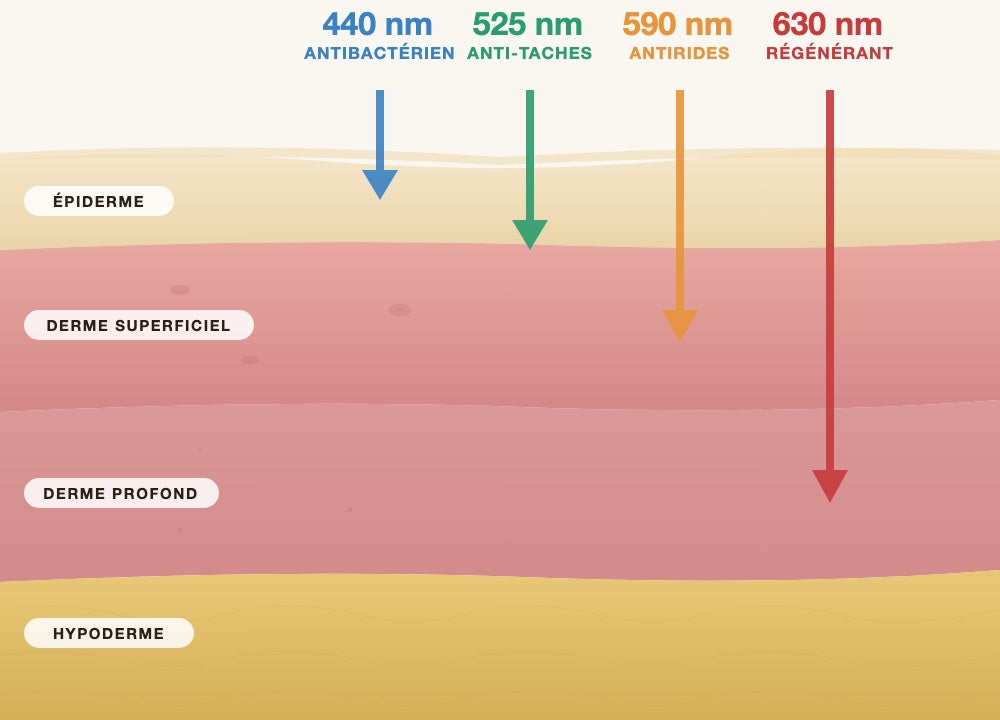
6 bespoke programmes
4 combined wavelengths over short sessions for targeted action: regenerating red (630 nm), anti-wrinkle orange-yellow (590 nm), anti-spot green (525 nm), antibacterial blue (440 nm).
The next-generation
biomimetic
LED mask
6 programmes · optimised cellular absorption


A unique biological modulation: warm-up · stimulation · recovery.
Red
630 nm
48mW/cm²
Irradiance
Light intensity
170 mcd
Orange-yellow
590 nm
40mW/cm²
Irradiance
Light intensity
135 mcd
Green
525 nm
32mW/cm²
Irradiance
Light intensity
100 mcd
Blue
440 nm
32mW/cm²
Irradiance
Light intensity
20 mcd
The technology explained
4 combined wavelengths over short sessions for targeted action: regenerating red (630 nm), anti-wrinkle orange-yellow (590 nm), anti-spot green (525 nm), antibacterial blue (440 nm).

Exclusive biological modulation (warm-up > stimulation > recovery) for optimal absorption of light without depleting the cells.
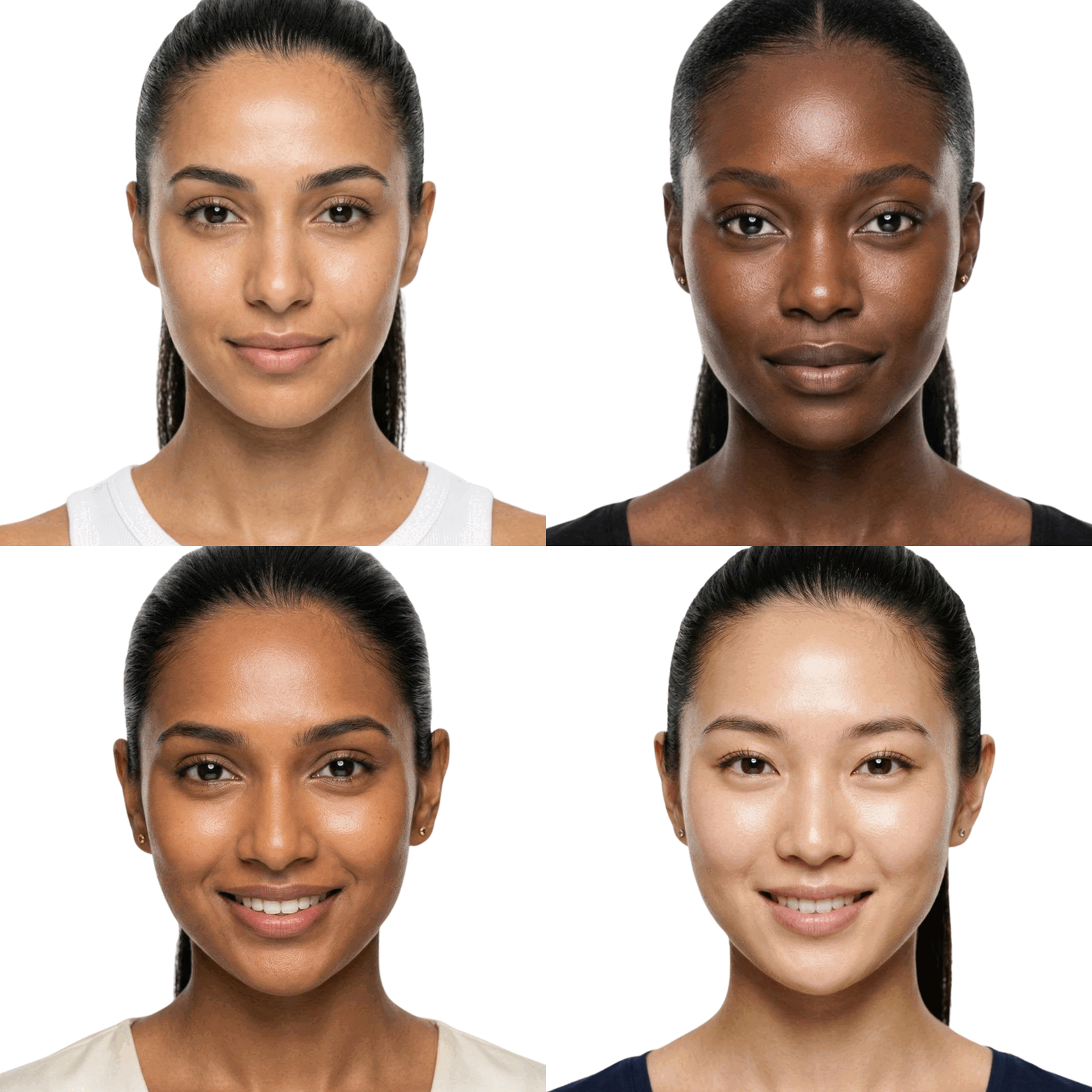
Infrared-free so as not to overheat the epidermis, suitable for sensitive skin and skin prone to hyperpigmentation (phototypes 3-6).
Why it's THE mask you need.
6 scientifically calibrated programmes, automatically combining 4 wavelengths over short times (3 to 6 minutes) to meet every need of the skin.
216 latest-generation multispectral LEDs covering the entire face.
A unique biomimetic dosimetry that respects the cells, delivering the precise dose of energy without saturating them.
No infrared so as not to risk overheating sensitive skin or skin prone to hyperpigmentation.
Simple, comfortable and fast to use.
A VERY competitive price with no compromise on quality.


Red light stimulates cellular energy and boosts collagen synthesis in the deep dermis. Orange-yellow light boosts collagen synthesis in the superficial dermis. Green light regulates melanin synthesis.
Green light curbs the overproduction of melanin, the brown pigment responsible for spots. Red light supports skin regeneration.
Blue light creates targeted oxidative stress on the skin's surface to destabilise the C. acnes bacterium responsible for blemishes. Red light soothes the inflammation associated with imperfections and regulates the activity of the sebaceous glands responsible for sebum secretion.
Red light soothes discomfort, reduces redness and regenerates the skin. Infrared-free so as not to overheat sensitive skin.
Red light stimulates microcirculation to oxygenate the tissues and deliver an instant healthy-glow effect. Orange-yellow light revives the skin's radiance day after day.
Green light curbs the overproduction of melanin responsible for dark spots. Red light limits post-inflammatory hyperpigmentation linked to blemishes and accelerates skin regeneration.
(1) Ex-vivo test – 590 nm. (2) Clinical test - 30 volunteers - 590 nm. (3) Clinical test - 30 volunteers - 525 nm. (4) Satisfaction test - 37 volunteers - 440 nm + 630 nm. (5) Clinical test - 36 volunteers - 440 nm + 630 nm. (6) Clinical test – 8 volunteers - 440 nm + 630 nm. (7) Clinical test - 25 volunteers - on redness after mesotherapy - 630 nm. (8) Clinical test - 30 volunteers - 590 nm.
Three steps, simply
Cleanse and dry the face. You can apply a skincare product before the session: all Talika serums and creams are compatible with the mask. Just avoid photosensitising products (retinol, high-dose AHAs), sunscreen and make-up.
Position the mask on the face and adjust the straps at the back of the head.
Select the programme number with the remote control. 3 to 6 minutes per session, with automatic shut-off. Intensive phase: 1 programme once a day. Maintenance phase: every 2-3 days.
Everything you need to know
Our clinical tests show that the first “radiant glow” and anti-redness effects are visible from the very first session, results on imperfections from 7 days, and the reduction of dark spots and wrinkles from 28 days.
Yes. It does not heat up the epidermis because it is free of infrared and UV radiation, and because it is specifically programmed to optimise the absorption of light by the cells without saturating or depleting them.
The mask does not heat up the skin and does not cause post-inflammatory hyperpigmentation. It is therefore suitable for all complexions, including phototypes 3 to 6 (medium to dark skin tones).
The LED Therapy Mask also offers 2 anti-dark spot programs:
– MODE 02 BROWN SPOTS for older, mildly inflammatory spots linked to UV exposure, skin aging and hormones (melasma).
– MODE 06 POST-BLEMISH MARKS for recent marks linked to breakouts.
NB: blue light, which can be pro-inflammatory when it comes from solar radiation, is perfectly controlled in the LED Therapy Mask so as not to cause hyperpigmentation.
The mask is in principle not contraindicated for pregnant and breastfeeding women, but it has not been specifically tested on this group, so we advise you to seek your doctor's advice before any use.
The mask has not been specifically tested on minors, so we advise you to seek their doctor's advice before any use.
To ensure optimal effectiveness and respect your skin's natural cell regeneration time, use your program:
We recommend using only 1 program per day. If you wish to use 2 programs, alternate them every other day.
Caution: do not use the 03 BLEMISHES and 06 POST-BLEMISH MARKS programs back to back on the same day, due to their high intensity.
It can be used on bare skin or after applying a skincare product to optimise its absorption by the skin. However, avoid potentially irritating products (retinol, exfoliants, etc.) and do not use the mask over make-up or sunscreen, which could reduce its effectiveness.
We recommend using only 1 programme per day. If you wish to use 2 programmes, alternate them every other day.
Do not use the 03 BLEMISHES and 06 POST-BLEMISH SPOTS programmes on the same day, owing to their high intensity.
The LED Therapy Mask does not generate UV. It complies with CE standards.
Clean the inner side of the mask with a soft cloth lightly dampened with 70-degree alcohol. Do not use abrasive cleaning products or solvents, and do not immerse the device.
Store the device flat in a dry place, away from dust and direct sunlight. Do not bend it excessively.
It contains the silicone LED mask, its wired remote control with programme selector, its adjustment straps and the user manual.
For France: 2-year manufacturer's warranty against any manufacturing defect on the talika.fr website.
Programme 01 — Global Anti-Ageing
From 14 days: +26% collagen synthesis (1).
From 28 days: -30% wrinkles (2) and -30% pigmentation (3).
Programme 02 — Dark Spots
From 28 days: -30% pigmentation (3).
From 56 days: -46% pigmentation (3).
Programme 03 — Imperfections
From 7 days: imperfections less visible: 78% (4).
Redness: -52% (5).
Shine: -14% (6).
Programme 04 — Soothing
Immediate effect: -52% redness (7).
Programme 05 — Radiance Boost
Immediate effect: +26.7% complexion radiance (8).
(1) Ex-vivo test – 590 nm. (2) Clinical test - 30 volunteers - 590 nm. (3) Clinical test - 30 volunteers - 525 nm. (4) Satisfaction test - 37 volunteers - 440 nm + 630 nm. (5) Clinical test - 36 volunteers - 440 nm + 630 nm. (6) Clinical test – 8 volunteers - 440 nm + 630 nm. (7) Clinical test - 25 volunteers - on redness after mesotherapy - 630 nm. (8) Clinical test - 30 volunteers - 590 nm.
| Color | Wavelength | Light intensity | Irradiance |
|---|---|---|---|
| Red | 630 nm | 170 mcd | 48 mW/cm² |
| Orange-yellow | 590 nm | 135 mcd | 40 mW/cm² |
| Green | 525 nm | 100 mcd | 32 mW/cm² |
| Blue | 440 nm | 20 mcd | 32 mW/cm² |
The biomimetic approach of the LED Therapy Mask is unique. It follows the Arndt-Schulz law in order to respect the biology of the skin cell without saturating or exhausting it.
The scientific literature consistently shows that biostimulating effects on skin fibroblasts and tissue healing are obtained within a very narrow dosimetric window, generally between 0.5 J/cm² and 10 J/cm².
For optimal assimilation without saturation, the programs of the LED Therapy Mask's various modes also follow a pattern of the type: WARM-UP ► STIMULATION ► RECOVERY.
| Mode | Settings | Energy | Biological actions |
|---|---|---|---|
| 01. Global Anti-Aging | Pulsed orange-yellow (45 sec) + continuous green (1 min) + continuous red (2 min) Total: 3 min 45 |
8.58 J/cm² |
Wrinkles · Firmness · Brown spots • RED light stimulates cellular energy and boosts collagen synthesis in the deep dermis. • ORANGE-YELLOW light boosts collagen synthesis in the superficial dermis. • GREEN light regulates melanin synthesis. |
| 02. Brown Spots | Continuous green (1 min) + continuous red (2 min) Total: 3 min |
7.68 J/cm² |
Ingrained brown spots • GREEN light curbs the overproduction of melanin, the brown pigment responsible for spots. • RED light supports skin regeneration. |
| 03. Blemishes | Continuous blue (3 min) + continuous red (3 min) Total: 6 min |
14.40 J/cm² |
Pimples · Excess sebum • BLUE light creates targeted oxidative stress on the skin's surface to destabilize the C. acnes bacterium responsible for pimples. • RED light soothes the inflammation associated with blemishes and regulates the activity of the sebaceous glands responsible for sebum secretion. |
| 04. Soothing | Continuous red (3 min) Total: 3 min |
8.64 J/cm² |
Redness · Discomfort • RED light soothes discomfort, reduces redness and regenerates the skin. • No infrared, so as not to overheat sensitive skin. |
| 05. Radiance Boost | Pulsed orange-yellow (45 sec) + continuous red (2 min 15) Total: 3 min |
7.38 J/cm² |
Dull complexion • RED light stimulates microcirculation to oxygenate the tissues and deliver an immediate healthy-glow effect. • ORANGE-YELLOW light revives the skin's radiance day after day. |
| 06. Post-Blemish Marks | Continuous green (1 min) + continuous red (3 min) Total: 4 min |
10.56 J/cm² |
Red & brown post-blemish marks • GREEN light curbs the overproduction of melanin, the brown pigment responsible for brown spots. • RED light limits the post-inflammatory hyperpigmentation linked to pimples and accelerates overall skin regeneration. |
Red light penetrates down to the deep dermis, where the fibroblasts are located: the cells responsible for producing the skin's support molecules (hyaluronic acid, elastin, collagen...).
Its photons are absorbed by a molecular structure capable of reacting to light, mitochondrial cytochrome C. This activation stimulates cellular energy production, fibroblast proliferation, and collagen and elastin synthesis to reduce wrinkles and fine lines, and regulates inflammatory cytokines to soothe and reduce redness.
Scientific references
Orange-yellow light acts specifically from the base of the epidermis, where the melanocytes responsible for hyperpigmentation are located, up into the superficial dermis, where the fibroblasts are located: the cells responsible for producing the skin's support molecules (hyaluronic acid, elastin, collagen...).
It sends a signal to the fibroblasts prompting them to synthesize collagen and elastin in order to reduce wrinkles and sagging skin. It also helps regulate melanocyte activity to reduce the synthesis of the pigment melanin, even out and brighten the complexion.
Use of this wavelength is recommended in pulsed mode to avoid vascular heating.
Scientific references
Green light penetrates down to the basal layer of the epidermis, where the melanocytes responsible for synthesizing the brown pigment melanin are located.
It acts on specific receptors (Opsin-3 photoreceptors) to inhibit the activity of tyrosinase, an enzyme involved in the formation of brown spots. This process blocks the overproduction and transfer of melanin without heating, and therefore without any pigmentary rebound effect.
Scientific references
Blue light penetrates only slightly and reaches the upper layers of the epidermis, home to billions of microorganisms.
Thanks to strict calibration, it can specifically target bacterial (Cutibacterium acnes) and fungal (Malassezia) porphyrins, generating oxidative stress that is lethal to these unwanted microorganisms when they are present in excess on the skin. Blue light thus helps reduce blemishes on acne-prone skin (pimples, excess sebum...).
The wavelength selected by Talika remains outside the zone of ocular phototoxicity associated with ultra-short blue wavelengths (Blue Light Hazard).
Scientific references
Using photobiomodulation on melanin-rich skin (phototypes 4 to 6) requires particular precautions to avoid post-inflammatory hyperpigmentation.
It is not recommended when the total fluence of the programs exceeds 10-15 J / cm² (check the precautions for use in your devices' instructions).
Eumelanin (brown melanin), present in high density in dark phototypes, has the biological role of massively absorbing visible light to protect the skin from the harmful effects of the sun.
The additional absorption of excessively high doses of light from electro-beauty devices can then result in heat being generated at the surface of the epidermis, triggering the release of pro-inflammatory interleukins that can induce post-inflammatory hyperpigmentation or worsen melasma.
Since infrared wavelengths are the ones in at-home LED devices that "saturate" skin cells the fastest (highest irradiances), Talika chose, as a precaution, not to include them in the LED Therapy Mask. We have included them in other devices, in an ultra-controlled way (for example in the Time Control 7+, with limited intensity, over very short one-minute durations and without the occlusion of a silicone mask).
Talika's LED Therapy Mask focuses on athermic and/or pulsed visible spectra, without infrared, and on short programs (3 to 6 minutes) to respect the integrity of dark skin.
Scientific references
6 TAILOR-MADE PROGRAMMES
that respect the cell
Blemishes · Brown spots · Wrinkles · Redness
Suitable for sensitive skin and all complexions.


